


"Refugees Are Not Defined by Their Displacement": Zainab Iradukunda on the KATAZA Programme and Building Self-Reliance in the Mahama Camp
Updated: Jul 28

Zainab Iradukunda is a young refugee from Burundi living in Rwanda and serving as a Growth Guide under the KATAZA Programme at Mahama Camp. This is her story, in her words.
What is KATAZA?
KATAZA is a three-year program (2024–2027) that helps young people in Rwanda start and grow businesses — especially young women running businesses in farming, tourism, and hospitality. It's led by the Development Bank of Rwanda (BRD), with funding from the Mastercard Foundation, and it works in 15 districts across the country.
The program does two main things: it connects businesses to affordable loans, and it gives them hands-on business coaching, so they have both the money and the know-how to grow.
KATAZA is really six organizations working as a team, each with its own job:
BRD runs the program and manages the money — the funds, guarantees, and insurance behind it all.
I&M Bank provides the loans, mainly to tourism and hospitality businesses.
AMIR trains banks and SACCOs to design loan products that actually work for young people and women.
AMI recruits and trains the "Growth Guides" — the mentors who work directly with businesses to get them loan-ready.
MVend brings savings groups online and links them to SACCOs and small loans through an app called Gwiza.
RWAMREC works on the human side: training people, and especially engaging men, to break down the unfair norms that keep women out of business and financial decisions.
The Role of Growth Guides
Growth Guides are the people-facing layer of KATAZA. AMI recruits, trains, and deploys 240 of them as community-based trainers across the programme's 15 districts, tasked with supporting 90,000 MSMEs, assessing their needs, identifying skill gaps, and delivering the practical training that makes a business finance-ready. In effect, a Growth Guide is the bridge between an MSME that needs capital and a financial institution that could actually lend to it. Zainab is one of these 240.
RWAMREC's Role: Why Gender Equality Is Part of a Finance Programme
Access to a loan doesn't help a business much if the person running it isn't the one allowed to decide how the money gets spent. That's the piece of KATAZA RWAMREC is responsible for: promoting gender-transformative economic empowerment by engaging men, women, and youth to challenge the unequal norms that limit women's participation in financial and business opportunities. In practice, that means training that doesn't only teach women to run a business — it works with men, as partners rather than obstacles, on the norms that would otherwise keep women out of the decision entirely.
Why Refugees, and Why Mahama
Rwanda hosts refugees and asylum seekers across five camps; roughly 90% of them live in camp settings rather than urban areas. Mahama, in Kirehe District, is the largest, home to more than 60,000 people spread across two sites and 18 villages, with its own refugee-led governance structure of executive, quartier, and village representatives. Scale like that brings real pressure.
A 2017 joint UNHCR and Civil Peace Service of GIZ (CPS/GIZ) assessment of peaceful coexistence in the camp traced much of the tension there back to one root: gender norms that concentrate money and decision-making with men. That imbalance showed up in intimate partner violence (IPV), extra-marital relationships, and, in the hardest cases, women turning to survival sex when they had no other route to income. Men weren't exempt either; the same rigid expectation that a man must be the sole provider became its own source of shame and conflict once displacement made that impossible.
This is the gap RWAMREC's gender-transformative training exists to close under the KATAZA programme, not just connecting refugees to loans, but changing who gets to hold and decide about money in the first place. It's the ground Zainab's own story is standing on.
The Shift I Felt in Myself
When I was a child, I believed that being a refugee meant I had fewer opportunities than other young people. I thought that because I had been forced to leave my home country, my dreams and ambitions would always be limited. Today, I know that this is not true. Living in Rwanda has shown me that refugees can build skills, create opportunities, and contribute meaningfully to their communities when they are given the chance. Through the KATAZA Programme, I have gained confidence, knowledge, skills, and hope for the future. Most importantly, I have learned that refugees are not defined by their displacement but by their talents, resilience, and determination to succeed. One of the biggest changes in my life was realizing that entrepreneurship and income-generating activities are not only for men. Before, I believed that a woman's role was mainly limited to household responsibilities. Today, I understand that women can be entrepreneurs, leaders, and decision-makers. This realization strengthened my own confidence first, and it's that shift in myself that I now try to help other young women reach through KATAZA.
The Ripple I See Around Me
Mahama Camp is home to more than 60,000 refugees. Through her role as a Growth Guide, Zainab supports fellow refugees from Burundi, the Democratic Republic of Congo, South Sudan, and other countries to develop business ideas and connect with financial institutions and SACCOs.
The change didn't stop with me. Through training that RWAMREC delivered under KATAZA, I learned the importance of gender equality, positive masculinity, and power-sharing in the household — and I've watched those same lessons move through my own community. Every day, I witness positive changes in Mahama Camp: families resolving conflicts instead of letting them escalate, men supporting their wives' businesses instead of controlling the household finances alone, and young women gaining the confidence to participate in economic activities. This isn't just something I feel, RWAMREC's Journey of Transformation, which I went through myself before being trained to deliver it to others, has now reached 35 couples in Mahama, 70 people in total. While challenges remain, these changes show that transformation is possible when people are given the right opportunities and support, not as one exceptional case, but as a pattern spreading household by household.
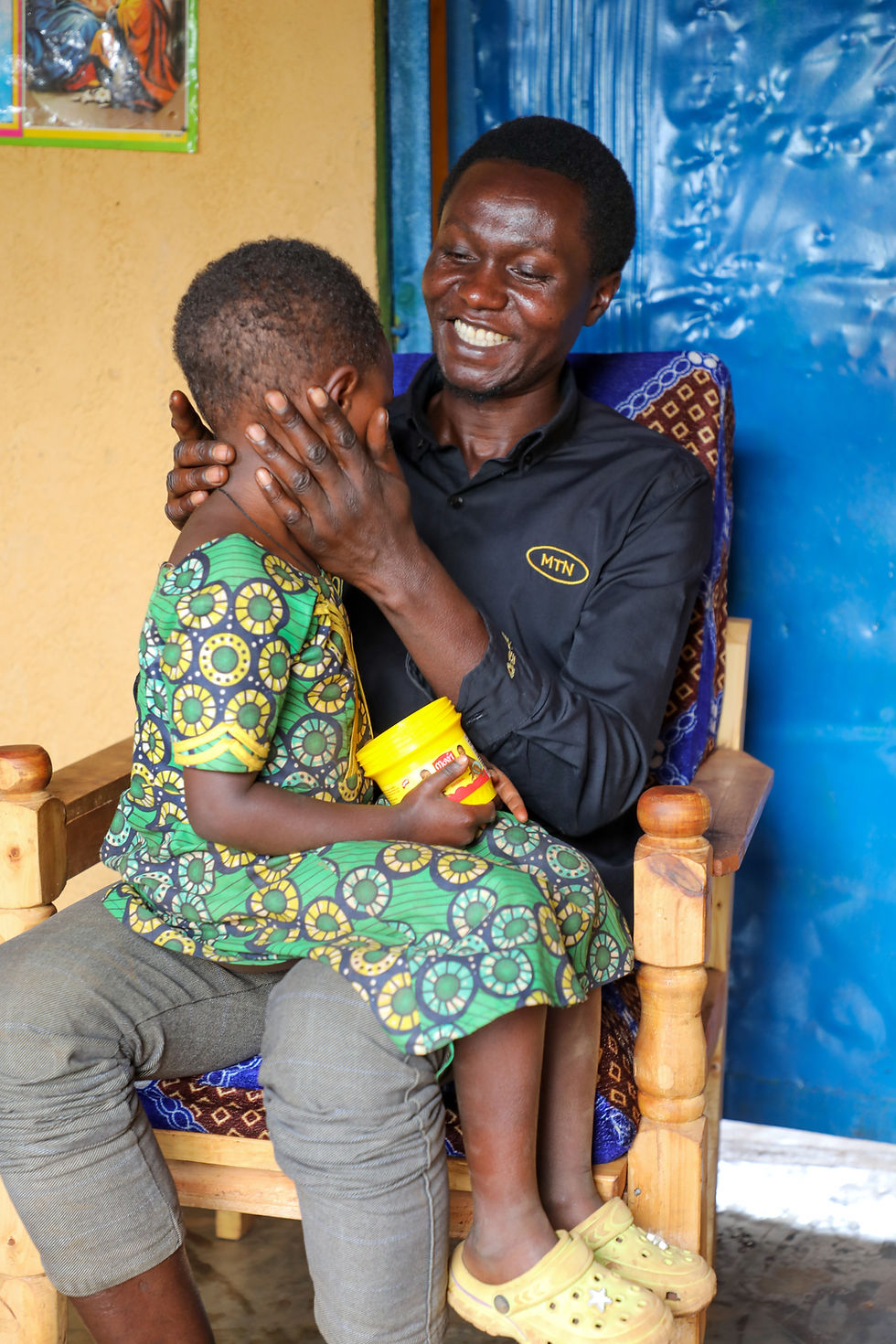
One session I remember clearly was with a couple who had joined the Journey of Transformation. The husband told the group that before, when his wife earned money, he wouldn't let her use it — he was the one who decided how it was spent. Sitting in that session, something shifted for him. He said it himself: a woman can run a business she cares about too, and he wasn't the only one who had to decide how they spent their money.
What makes me most proud is helping young refugees, persons with disabilities, and young women access finance. Among the 27 Village Agents I've trained on the Gender Transformative Approach (GTA) in Mahama, seven live with a disability, and through the savings group I work with, I have directly supported more than 8 people with disabilities to save, plan, and take their first steps toward their own income.
What I do through the KATAZA programme
KATAZA is a three-year initiative (2024–2027) led by the Development Bank of Rwanda in partnership with the Mastercard Foundation, working to expand access to affordable finance for youth- and women-owned MSMEs. Within that coalition, RWAMREC's specific role is to promote gender-transformative economic empowerment by engaging men, women, and youth to challenge unequal norms that limit women's participation in financial and business opportunities.
I completed high school in Computer Science and joined the KATAZA Programme, where I received training and support that enabled me to help other young refugees — especially young women and persons with disabilities — access opportunities for economic empowerment. I've been a Growth Guide since the end of 2025, recruited and trained through AMI, KATAZA's partner responsible for preparing Growth Guides like me to mentor and support MSMEs.
Many programmes that promote financial inclusion do not always reach refugee communities. KATAZA intentionally included refugees, connecting us with opportunities that can help us become self-reliant. Through my role, I've raised awareness about the KATAZA Programme among 100 people in Mahama. Of those, more than 60 applied to open an account with SACCO Mahama, the SACCO I work with directly and 8 have opened an account and received a loan so far. I've also gone through KATAZA's own training pathway myself — the Gender Transformative Approach (GTA), the Journey of Transformation (JoT), and the Training of Trainers for JoT — which qualified me to pass that training on to others.

My message: Until Everyone Is Safe
On World Refugee Day, Zainab’s message is direct:
As we mark World Refugee Day, I encourage people everywhere to recognise the talent, resilience, and potential that exists within refugee communities. When refugees are given opportunities, we do not only transform our own lives, we also transform the communities around us.
There's one more thing I want to say, because I watched it happen with my own eyes: gender equality is not only a women's issue. I still think about that husband, sitting in the circle during our Journey of Transformation session, the day he finally said it out loud, that his wife could run a business of her own, and that he wasn't the only one who got to decide how their money was spent. Something loosened in him as he said it. Like he'd been carrying a weight he hadn't realised was his to put down. His family didn't lose anything the day he let go of that control. They gained a second income. They gained a business. And, by his own account, they gained a marriage where two people sit down and solve problems together, instead of one person deciding alone in a room.


Comments