


Harvesting Equality: How young farmers are redefining the harvest this Umuganura through Shora Neza
A story of one household, thousands of families, and the growing link between gender norms, agriculture, and a changing climate.

Each year, as Umuganura approaches, Rwandan households across the country prepare to give thanks for the harvest — the crops that came in, the season that is closing, the year that is ending. In the Maraba Sector of Huye District, Niyonagize and Nikuze, parents of three, are preparing to celebrate a different kind of harvest this year. Their beans came in well. But what they describe first is something else entirely.
“This year we harvested beans and the production was good. But most importantly, I harvested peace and calm in my home because I now have a good relationship with my husband.”
— Nikuze, Shora Neza participant
A household divided by an old pattern
For most of their married life, decisions in Niyonagize and Nikuze's household followed a pattern common across many Rwandan farming families. “Before joining Shora Neza, my husband made all the family decisions, including what we farmed and deciding what to do with the harvest. I was mainly responsible for taking care of the children and doing household work,” Nikuze remembers.
Niyonagize describes the same arrangement from where he stood, and the belief that underpinned it: “I believed that the husband was the one who should make all the decisions, because he was the head of the household — the ‘lion’ of the family. I saw the woman as someone responsible only for household chores and taking care of the children. When there was money or agricultural decision-making, I was the one who made the decisions and allocated money to my wife because I felt that I was the one working hard for it.”
When the harvest was good, this arrangement went unquestioned. When it was poor, the imbalance became a burden Nikuze carried largely alone. “It was a major burden for me because I had to do everything possible to make sure the children had something to eat, especially because my husband did not pay attention to it. He used to spend the little money we had on drinking alcohol,” she says.
It is a pattern RWAMREC's Community Facilitators recognize across the districts where Shora Neza works. “Previously, men were usually the only ones making decisions about money and farming, as they themselves acknowledge,” one facilitator explains, describing families before the programme reaches them.
A conversation that changed the household
The turning point for Niyonagize and Nikuze came through the Shora Neza Journey of Transformation (JoT) — a gender-transformative training that walks couples through gender, power, shared responsibility, and the different forms of violence that unequal households can produce. What made the difference, the couple says, was not only the training sessions themselves but the weekly household exercises that followed.
“The household exercises helped us. They encouraged us to sit together and review what we had learned. This helped us with our family planning, and we were very happy because the conflicts we used to have stopped,” Nikuze says. “RWAMREC should continue reaching many more people,” she adds.
“I learned that a family develops when a husband and wife work together. Now we discuss before making decisions, share household responsibilities and plan our income together.”
— Niyonagize, Shora Neza participant
The change was gradual rather than dramatic, and it was not always comfortable. “At the beginning, it was not easy, especially with some household chores that I felt embarrassed to do. Sometimes I refused to do them because I felt that my wife would look down on me,” Niyonagize admits. “But as we continued discussing what we were learning during the sessions, things changed. Now there is no problem at all. We share everything, and whenever there is a problem, we sit down and discuss it.”
Nikuze was the first to see it. “My wife was the first person to notice the changes. She told me that she was happy because I now listen to her and we sit together and discuss things,” Niyonagize says. “Our neighbors and relatives also say that they see more harmony in our household than before.”
Together, the couple started making joint choices about what to farm, how to spend, and how to prepare for the future — including joining a savings group so that access to seeds and fertilizer no longer depends on any one person's decision. “Making decisions together means that we farm what we have jointly agreed will give us a good harvest,” Nikuze says. Niyonagize points to something a neighbour could see for themselves: “You can see that we have started putting sand on our house, something we had previously been unable to do.”
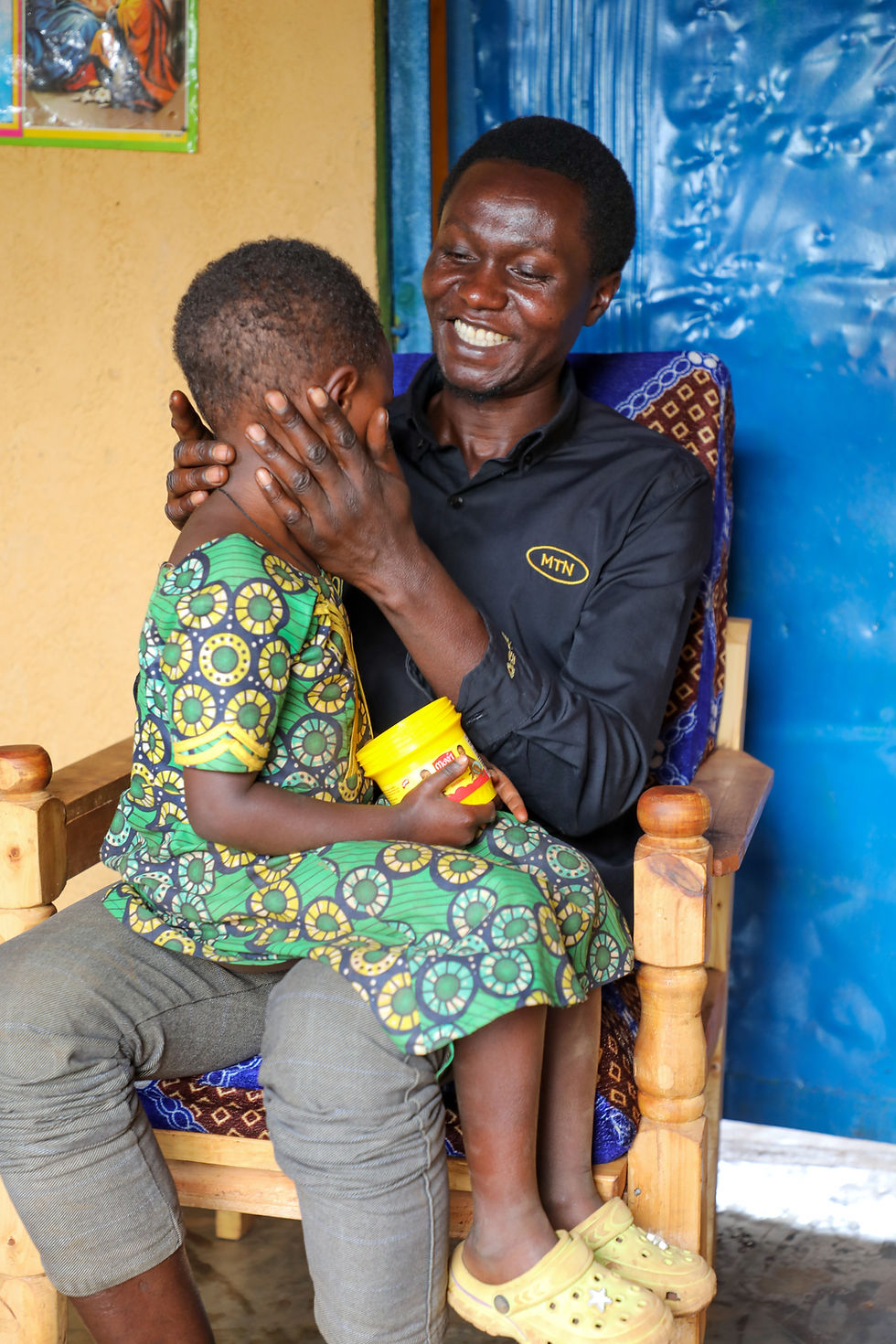
Their three children, they say, are now noticeably more comfortable around both parents. “The children have benefited greatly because they are now more comfortable with their parents. They are no longer afraid of their father, and they now receive their basic needs without problems,” Nikuze says.

Why gender equality is a climate adaptation strategy
Farmers across the districts where Shora Neza operates describe a climate that no longer behaves the way it used to. “In the past, rainfall came at the expected time and farmers knew when to plant. Now, rain may come late, fall heavily and cause erosion, or come in insufficient amounts and cause drought,” Niyonagize explains. “What surprises us is that we can no longer predict agricultural seasons as well as we used to.”
The consequences reach beyond the field. “The major challenges include unusual rainfall, drought, crop diseases and pests, and the continued increase in the cost of agricultural inputs... This can cause household nutrition to deteriorate and reduce the household's financial capacity,” he says. And that pressure, in this context, is not distributed equally. “As a man, my family expects me to find solutions and continue taking care of them because they believe that a man can do everything. Even when the harvest is poor, they expect me to find food, money for household needs, health insurance contributions and other necessities,” Niyonagize says of the expectations placed on him.
Before Shora Neza, that pressure had a familiar outlet. “Before, I would become discouraged. Sometimes I felt that there was nothing else I could do, which made me feel ashamed and hopeless. There were also times when I would waste money on things that were not useful to the family, such as drinking alcohol,” Niyonagize recalls. “But now my wife and I sit together and consider what we can change. We plan the money that remains and look for other ways to meet the family's needs. This helps us avoid making decisions out of panic.”
A Community Facilitator connects the dots between resource scarcity and conflict directly: “When food, water or money becomes scarce, it can create stress and a negative atmosphere at home. A person may become angry or anxious because they cannot provide what the family needs... One person would feel that money had been spent on unnecessary things, while the woman would find that she was the one carrying the burden. But now we have learned that we should discuss issues and look for solutions together instead of blaming each other.”
This is the case for treating gender-transformative work as more than a social good — it is a resilience strategy for agriculture. Niyonagize is candid about how much harder the provider role has become: “They have become much more difficult because of climate change, rising prices and declining production, as well as the feeling that I, as a man, carry everything on my shoulders. However, because we now make decisions together, plan our resources and work together, the burden is no longer carried by the husband alone.”
Change has not reached everyone yet. “Some have not changed their attitudes and still believe that they are the ones who must carry all the family's problems as men. When they face difficulties, they become discouraged or choose to drink alcohol, which makes family problems worse,” Niyonagize observes of other men in his community. Facilitators describe the specific social pressure that keeps men from changing: “The biggest challenge we encountered was people's attitudes and expressions such as ‘he has been fed isombe’ or ‘he has become controlled by his wife.’ Some men were also embarrassed to perform certain household chores. However, we continued engaging with them, providing discussions and using testimonies from families that had experienced positive changes... Gradually, they began to see the benefits of these changes, and many changed their attitudes.”
Niyonagize's message to men still holding onto the old model is blunt:
“Valuing their wives' ideas and sharing responsibilities does not make them less of a man or make them ‘controlled by their wives.’ Instead, it helps the family develop and live together peacefully. When you talk together, make decisions together and work together, peace increases, productivity increases, and children grow up in a peaceful family.”
Inside the cascading model — how one household's change multiplies
Niyonagize and Nikuze's experience is one thread in a much larger fabric. A Community Facilitator sums up the broader shift across the families Shora Neza has reached: “The changes we are seeing are many and visible. Men have started sharing household responsibilities with their wives. This gives women more time to participate in activities that improve their wellbeing and increase productivity. We have also seen household conflicts decrease, greater harmony, and families beginning to plan for the future. Some are joining savings groups, whereas previously they had not done so.”
Shora Neza works through a cascading model designed to carry gender-transformative approaches from a small group of trainers to thousands of farming households:
RWAMREC's trainers conduct a Training of Trainers, equipping 100 Community Facilitators, 50 women and 50 men, through a 5-day Journey of Transformation training and a 3-day Gender-Transformative Approach (GTA) training.
Community Facilitators then work in pairs across sectors, delivering the Journey of Transformation to couples and training Gender Champions in GTA.
1,290 couples (2,580 people) — young women farmers and their partners, plus family support champions — take part directly in the Journey of Transformation, reaching a total of 2,580 farmers through couple dialogues.
70% of participating couples go on to create Men Engage Clubs, extending the conversation indirectly to more men and reaching an estimated 2,700 farmers.
Gender Champions, unmarried young farmers and family influencers trained in GTA, run community dialogues that reach 6,450 married and unmarried farmers.
Since implementation began in October 2025, this model has rolled out across 43 sectors in 18 districts: Bugesera, Gatsibo, Kayonza, Rwamagana, Ngoma, Musanze, Rulindo, Gicumbi, Burera, Gakenke, Huye, Muhanga, Nyanza, Nyaruguru, Ruhango, Nyabihu, Nyamasheke, and Rubavu. Facilitators have achieved a 98% participation rate in their own training, and have shown measurable improvements in knowledge and attitudes around gender norms, joint decision-making, shared household responsibilities, and the prevention of gender-based violence.
A programme built for young women's economic future
This work sits inside the broader Shora Neza Programme, implemented by RWAMREC in partnership with the World Food Programme, which addresses the social and behavioural barriers limiting young women's participation in agribusiness, agricultural finance, and youth employment. The gender-transformative component — the Journey of Transformation for married farmers and gender-transformative approaches for unmarried farmers — works alongside the programme's efforts to expand young women's access to markets, finance, and employment, on the understanding that access alone is not enough if household norms still stand in the way of a young woman's ability to use it.
Looking ahead
This reporting period reflects the programme's start-up and initial implementation phase. Facilitators are already looking toward what comes next: “
“Community Facilitators emphasized the importance of ensuring that those who have been trained continue to serve as positive examples in their communities, so that the changes can be sustained and reach more families. They expressed a strong desire to see safer, more united families and for Shora Neza to reach more people, as some families still maintain behaviours and attitudes that can contribute to violence.”
— RWAMREC Field Coordinator, reporting on Community Facilitators’ reflections
Building on this foundation, Shora Neza is set to scale further in 2026, engaging thousands more Gender Champions, couples, and local leaders across Rwanda's 18 participating districts. For Niyonagize and Nikuze, that future is already visible in their own household. “I would like us to continue working together with my husband, both in planning the farming season and discussing how the harvest will be used. This makes me feel that I am valuable and that what we are doing should help us achieve development,” Nikuze says.
“This Umuganura will be different from previous ones. We celebrated harvests before, but I was not happy because I felt that I had not played a role... But this time I will be happy because we worked together to produce the harvest. We will share it while living peacefully, and we are also planning together how we will farm better in the next season.” — Nikuze
This Umuganura, as families across Rwanda give thanks for the harvest, RWAMREC is proud to be helping households harvest something else too — investing in gender-transformative programming that helps more couples move from conflict to dialogue, from unequal burdens to shared responsibility, and from vulnerability to resilience.

Let us help more families harvest what matters most: equality, peace, partnership, dignity and hope.


Comments