


RWAMREC Welcomes Rwanda’s First National Strategy Engaging Men and Boys for Gender Equality: A Milestone We Proudly Advocated For
Rwanda has taken a historic step with the adoption of the National Transformative Strategy Engaging Men and Boys for Gender Equality Promotion, a groundbreaking policy that positions men and boys as essential partners—and co-beneficiaries—in advancing gender equality nationwide. RWAMREC warmly welcomes this important milestone, which directly builds on more than 15 years of our advocacy, evidence generation, and programmatic leadership in promoting positive masculinities and the MenEngage approach.

A Policy Shift RWAMREC Helped Make Possible
The Revised National Gender Policy (2021) called for a national strategy to operationalize the engagement of men and boys (Policy Action 5.1.1). RWAMREC played a central role in shaping this vision—sharing evidence, supporting consultations, and demonstrating, through years of implementation, that transforming masculinities is essential to sustain Rwanda’s progress in gender equality.
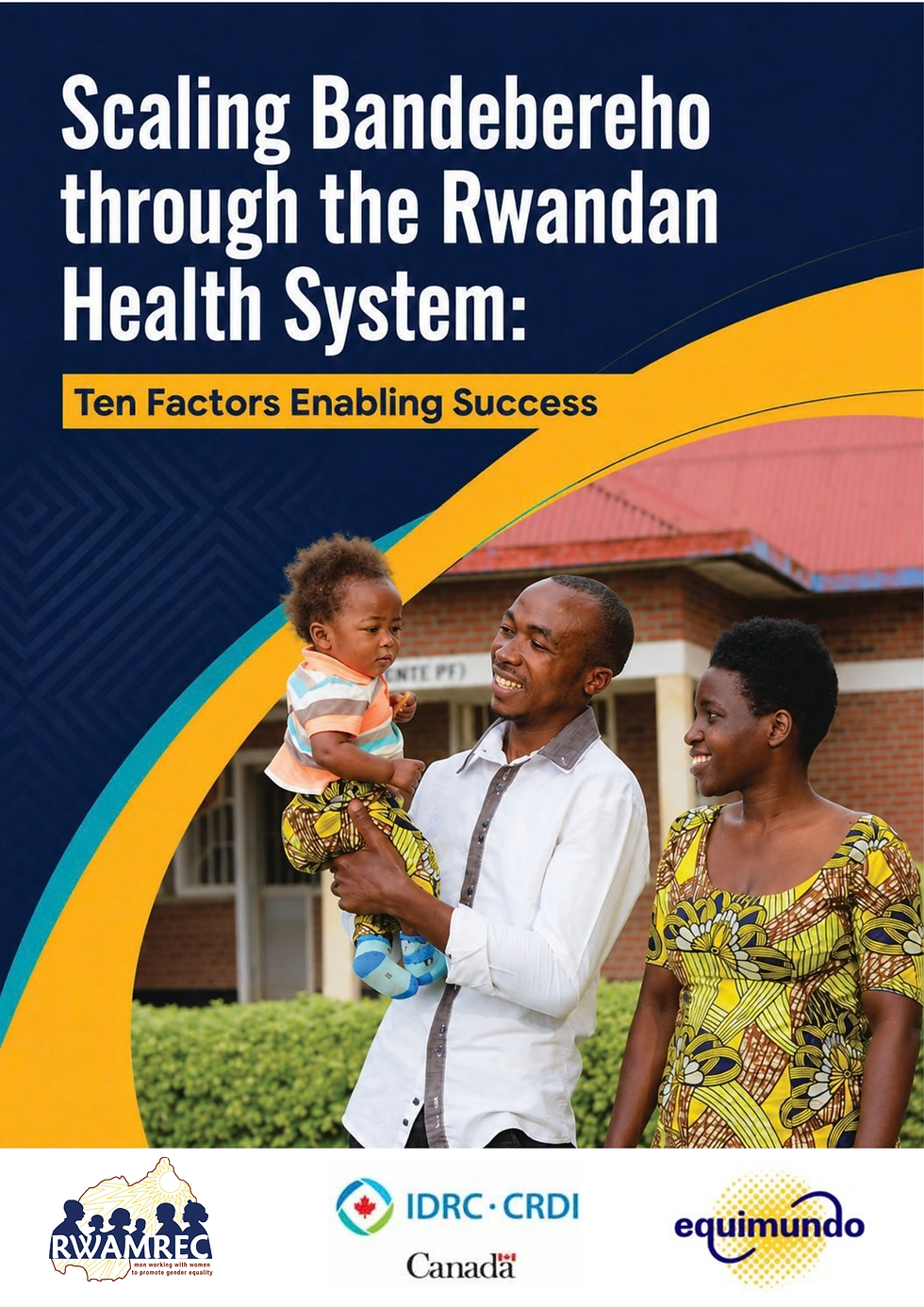
Through models such as BANDEBEREHO, Indashyikirwa, positive parenting interventions, community dialogues, youth engagement, and work in correctional facilities and schools, RWAMREC consistently advocated for a coordinated, national framework. The new Strategy integrates many of these proven principles—including gender-transformative methodologies, accountability to women’s rights movements, and system-wide action across health, education, GBV prevention, unpaid care work, economic empowerment, and governance.

Why This Strategy Matters
The Strategy acknowledges that although Rwanda is a global leader in gender equality, deep-seated norms still shape power dynamics in households, communities, institutions, and the economy. Women continue to face barriers in economic empowerment, decision-making, unpaid care work, political participation, and safety. Rigid masculinities also negatively affect men and boys—limiting their emotional expression, health-seeking behaviors, and relationships.
By promoting positive, caring, equitable masculinities, the Strategy aligns with RWAMREC’s long-standing conviction:Sustainable gender equality cannot be achieved unless men are intentionally engaged as allies, partners, and co-beneficiaries.

RWAMREC’s Contribution: Evidence, Models, and Advocacy
RWAMREC’s contribution to this Strategy has been multi-layered:
1. Pioneering the engagement of men and boys in Rwanda
Since the early 2000s, RWAMREC introduced the concept of transforming masculinities, laying the groundwork for national acceptance of EMB approaches.
2. Generating national and global evidence
Programs such as Bandebereho and Indashyikirwa have provided rigorous proof that gender-transformative programming reduces violence, improves couple communication, strengthens parenting, and supports women’s empowerment.
3. Advocacy within the MenEngage Alliance
As part of MenEngage Africa and the global alliance, RWAMREC has helped situate Rwanda within a global movement, ensuring international standards and accountability principles inform national practice. Our advocacy spans multiple levels: globally as an ECOSOC-accredited NGO, at the UN Commission on the Status of Women (CSW), at the continental level through our observer status at the African Union, and within regional conventions addressing masculinities, early childhood development, and violence prevention.
4. Supporting policy consultations and technical processes
RWAMREC actively contributed to MIGEPROF-led consultations, policy dialogues, and evidence reviews, highlighting the need for a strategy that moves beyond awareness to norm transformation, accountability, and systemic change.
5. Strengthening national ownership
By collaborating with government institutions, women’s rights organizations, youth structures, districts, and communities, RWAMREC demonstrated the feasibility of scaling positive masculinity interventions across different sectors and age groups.

What the Strategy Envisions—and How RWAMREC Will Support It
The Strategy aligns with national priorities under the NST pillars of social transformation, economic transformation, and transformative governance. It focuses on three thematic areas where engaging men and boys is essential:
Social inclusion: health, SRHR, GBV prevention, education, unpaid care work, fatherhood
Economic empowerment and climate justice: women’s livelihoods, access to finance, gendered impacts of climate change
Transformative governance: women’s leadership, voice, and decision-making at all levels
RWAMREC remains fully committed to supporting implementation through:
✔ Capacity-building for institutions and districts
✔ Curriculum development and training based on gender-transformative approaches
✔ Work with youth, couples, and fathers
✔ Private-sector engagement on workplace norms and sexual harassment
✔ Strengthening accountability mechanisms within the EMB movement
✔ Continued evidence generation to inform scale-up and adaptation

A Collective Win for Gender Equality in Rwanda
The adoption of the National Transformative Strategy Engaging Men and Boys represents a collective victory for Rwanda’s gender equality movement. It confirms the country’s leadership while responding to persistent gaps identified by both government and civil society.
RWAMREC is proud to have contributed to this achievement and looks forward to supporting MIGEPROF, districts, institutions, and partners in bringing the Strategy to life.
Transforming masculinities is not just a programmatic choice—it is a national commitment. A more equal Rwanda is possible when men and boys walk the journey alongside women and girls.



Comments