


RWAMREC Launches Updated 2022–2026 Strategic Plan with Extension to 2028: A Bold Roadmap for Gender Equality in Rwanda

Rwanda Men's Resource Centre (RWAMREC) has unveiled its updated Strategic Plan, extending its 2022–2026 vision through 2028 with sharper priorities, a streamlined structure, and a renewed commitment to transforming masculinities and ending gender-based violence (GBV) in Rwanda and across the region.
What Is RWAMREC and Why Does This Strategic Plan Matter?
Founded in 2006 and legally established in 2008, RWAMREC is Rwanda's leading non-governmental organization dedicated to achieving gender equality by engaging men and boys as active allies in preventing gender-based violence. Operating across all 27 districts of Rwanda, RWAMREC has spent nearly two decades reshaping the conversation around masculinity, family health, and community safety.
The newly released strategic plan — officially titled the RWAMREC Update 2022–2026 and Extension to 2028 Strategic Plan — is not simply a continuation of past work. It represents a thorough, evidence-based recalibration of the organization's direction, informed by a comprehensive mid-term review and consultations with over 30 stakeholders including staff, community members, donors, and government partners.
From Six to Four: A Streamlined Strategic Framework
One of the most significant changes in the updated plan is the consolidation of six Key Result Areas (KRAs) into four focused pillars. Two cross-cutting themes — Gender Justice and Diversity & Inclusion — have been mainstreamed across all areas rather than managed in silos. The four KRAs for 2025–2028 are:
Community Empowerment and Sustainability
Peaceful and Healthy Families
Youth Mentorship and Child Support
Institutional Capacity Development
This streamlined approach reflects a strategic choice to go deeper rather than wider — concentrating resources and expertise where RWAMREC can drive the greatest, most lasting change.
Key Result Area 1: Community Empowerment and Sustainability
RWAMREC recognizes that gender-based violence is rooted in socially constructed norms. The first KRA targets these roots directly by raising awareness among key stakeholders, building community structures capable of identifying and responding to GBV, and strengthening local mechanisms for violence prevention.
A notable addition in this plan is the integration of climate resilience into gender equality programming. RWAMREC will engage men and boys as partners in gender-equitable climate action — conducting community dialogues on how restrictive gender norms worsen climate vulnerability and promoting male-inclusive green livelihoods such as renewable energy and sustainable agriculture.
Key Result Area 2: Peaceful and Healthy Families
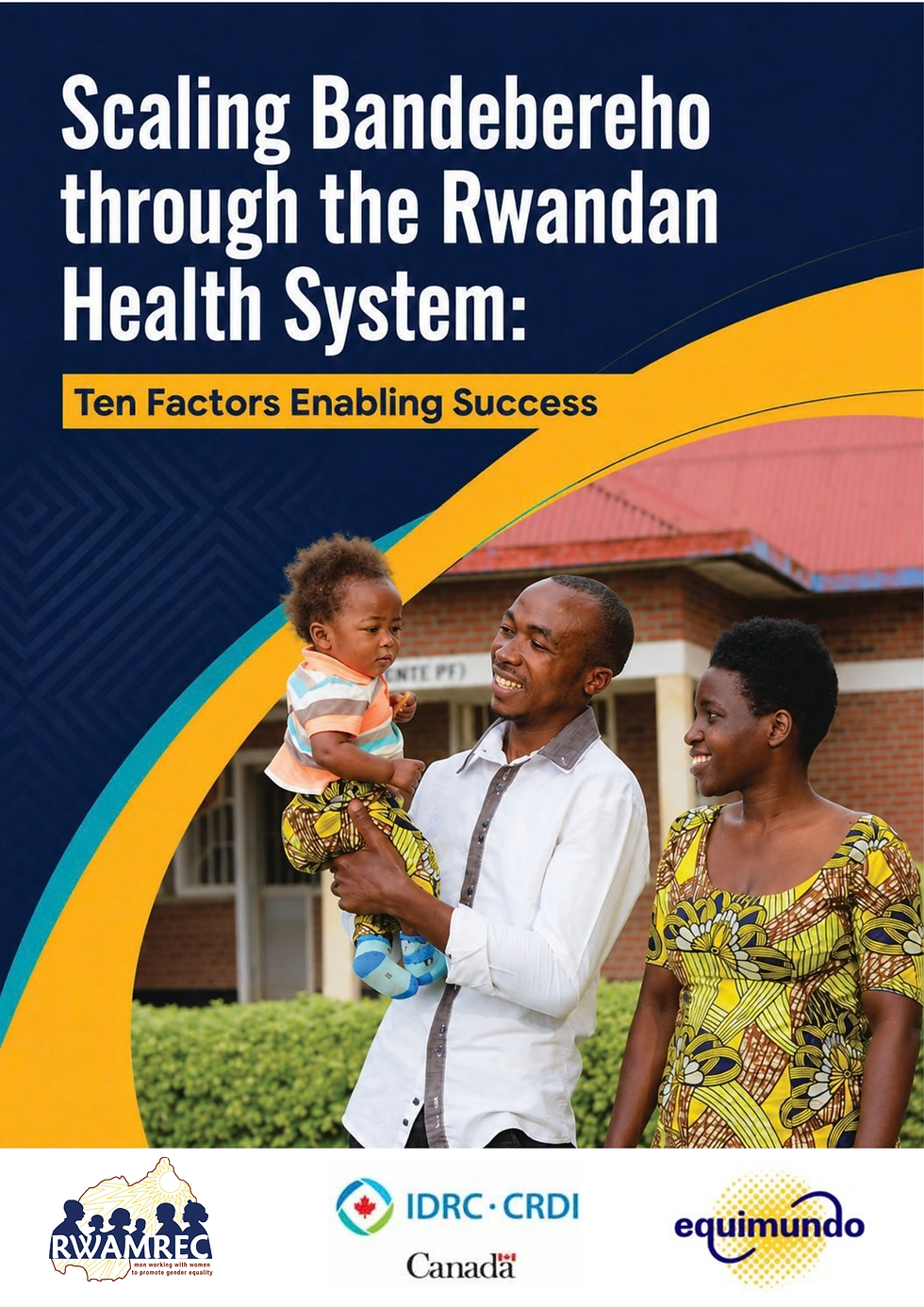
The family is both the site of some of the greatest harm caused by GBV and the most powerful arena for transformation. Under this KRA, RWAMREC will scale up its flagship Bandebereho program — a couples-based, gender-transformative initiative whose six-year Randomized Controlled Trial demonstrated a 45% reduction in intimate partner violence among participants.
The updated plan targets 104,000 families through Bandebereho by 2027. Beyond this, RWAMREC will establish free, confidential counseling services for couples and families, promote male engagement in reproductive and maternal health, and strengthen survivor-centered GBV service delivery through standardized protocols and multi-sector referral systems.
Key Result Area 3: Youth Mentorship and Child Support
With over 40% of Rwanda's population under the age of 15, investing in young people is not optional — it is essential. This KRA focuses on promoting positive masculinities and femininities among adolescents and youth aged 10–24, with targeted programming to challenge harmful gender stereotypes before they become entrenched.
RWAMREC's school-based initiatives — including Boys4Change, Girls Take the Lead clubs, and Youth4Change safe spaces — will be expanded and strengthened. The plan also addresses the crisis of teenage pregnancy, a concern underscored by UN Women data showing more than 17,000 cases nationally in 2017, with a 35.3% increase by 2019. Comprehensive reproductive health education and peer-to-peer education models are central to this KRA's strategy.
Key Result Area 4: Institutional Capacity Development
Transformative social change requires a strong, sustainable organization to drive it. This KRA addresses RWAMREC's internal growth priorities: building a centralized Monitoring, Evaluation, Learning and Impact (MELI) system; diversifying funding beyond traditional donor grants; strengthening communication and visibility; and establishing a regional training hub to build capacity across East Africa and generate sustainable income through fee-based services.
The plan sets an ambitious fundraising target of USD 12,141,057 for the full strategic period, with goals to mobilize $10 million cumulatively by 2028 and establish at least five strategic partnerships through the regional hub by 2026.
A Theory of Change Built on Evidence
RWAMREC's updated Theory of Change is grounded in decades of field experience and rigorous research. It operates on the conviction that lasting gender equality requires change at multiple levels simultaneously — within individuals, households, communities, and institutions.
By engaging men not as bystanders but as proactive allies — supportive fathers, equitable partners, and community change agents — RWAMREC creates a ripple effect: transformed men influence families, transformed families shape communities, and transformed communities shift institutions. Programs like Bandebereho, GEWEP, TINYUKA, and Wisigara Umugore exemplify this multi-level approach in practice.
Vision and Mission: Unchanged, Unwavering
At the heart of this strategic plan lies an unchanged vision:
"A peaceful society where women and men share roles and responsibilities in raising families and governing society through equality and respect."
RWAMREC's mission — to promote gender equality through transforming masculinities and femininities — is operationalized through awareness creation, advocacy, capacity development, movement building, and service delivery. Its core values of Safety, Equality, Empowerment, Systematic Change, and Partnerships anchor every program and decision.
Standing Firm in Challenging Times
RWAMREC's Board Chairperson, Rosette Uwizera Mukankomeje, captures the spirit of this moment in the plan's foreword:
"At a time when the feminist movement and gender equality are under attack, we do not step back. We remain steadfast in our vision of a peaceful society where men, women, persons with disabilities, youth, refugees, and those not recognized in these categories share responsibilities in their families, communities, countries, and the world."
Founder and Executive Director Fidéle Rutayisire echoes this resolve, acknowledging that RWAMREC's work would not be possible without the women who raise their voices, the men who step out of the "man box," and the young people who choose non-violence over replication of harm.
What This Means for Rwanda and the Region
Rwanda already ranks among the world's leaders in gender equality — placing 39th globally in the Global Gender Gap Index and consistently recognized for high levels of women's political representation. RWAMREC's work both builds on and advances this national commitment, aligning with Rwanda's Vision 2050, the National GBV Prevention Strategy, and the UN Sustainable Development Goals, particularly SDG 5 on Gender Equality.
The plan's ambition to establish a regional training hub signals a shift in RWAMREC's role — from a nationally focused NGO to a regional thought leader and knowledge hub on masculinities, male engagement, and GBV prevention across East Africa and beyond.
How to Engage With RWAMREC
Whether you are a donor, researcher, civil society organization, government partner, or community leader, RWAMREC invites collaboration. The updated strategic plan outlines clear stakeholder engagement pathways — from policy dialogues and joint research to community outreach and survivor-informed program co-design.
Contact RWAMREC:
Address: KK 15 Ave, Yyusa Plaza, Kimironko, 2nd Floor, Kigali, Rwanda
Email: info@rwamrec.org
Website: www.rwamrec.org
Phone: +250 788 381 183 / +250 788 315 140
Together, let us continue to transform masculinities, challenge harmful norms, and build a society that values equality for all.


Comments