


Bandebereho Scale-Up: 10 Factors That Took a Pilot into Rwanda’s Health System
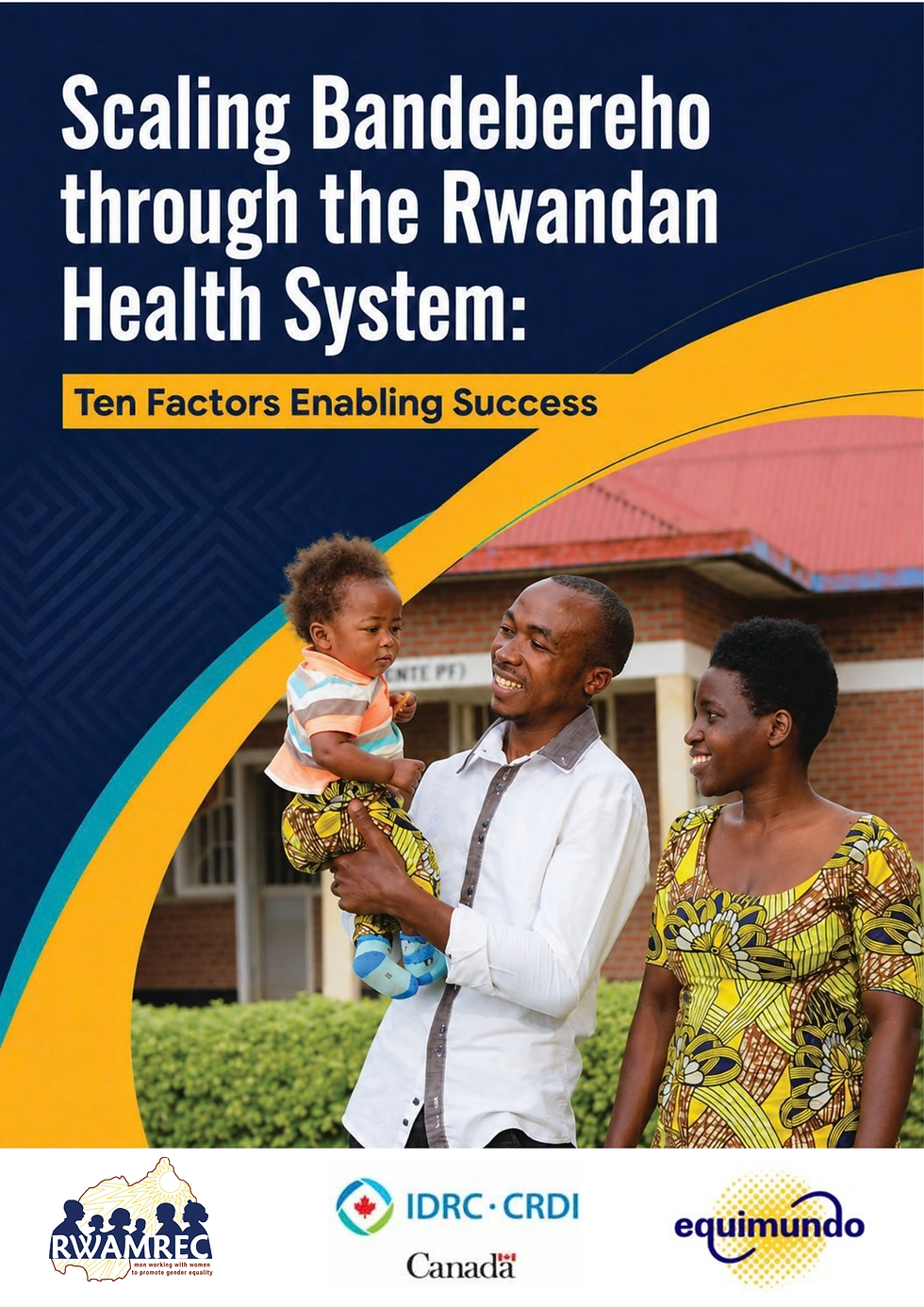
A new RWAMREC and Equimundo brief traces the Bandebereho scale-up from a 16-community pilot to a programme delivered by community health workers, now reaching over 95,000 men and women. Here are the ten factors that made it possible – and what other organisations can learn from them.
Most non-profits know the challenge well: a programme works in a pilot, the evidence is strong, but taking it to scale feels out of reach. Partnering with government is one of the most promising routes, yet there is no single roadmap for doing it well.
A new brief by RWAMREC and Equimundo, Scaling Bandebereho Through the Rwandan Health System: Ten Factors Enabling Success, offers one. Drawing on more than a decade of work with the Government of Rwanda, it documents the wins, challenges and setbacks of the Bandebereho scale-up – and distils them into practical lessons for others on a similar path.
What is Bandebereho?
Bandebereho, meaning “role model” in Kinyarwanda, uses fatherhood as an entry point to work with men to build caring, non-violent relationships with their partners and children. Expectant fathers and fathers of young children join weekly small-group sessions in their communities – 17 sessions in the scale-up curriculum, ten of them with their partners.
The programme takes a gender-transformative approach, intentionally challenging the gender norms and power imbalances that limit men’s engagement in maternal and child health and caregiving, and that fuel violence. Today, community health workers deliver Bandebereho in three districts, reaching over 95,000 men and women, with expansion underway in a fourth.
From pilot to the health system: the journey
The path was neither linear nor easy. It moved through four phases:
• Adaptation and pilot (2013–2015). Adapted from Program P, the curriculum was piloted in 16 communities across four districts. More than 3,500 parents took part, with men attending 94% of sessions.
• Evidence and pathway to scale (2016–2018). A randomised controlled trial with around 1,200 couples found improvements in maternal health-seeking, family planning, men’s share of childcare and household work, and women’s role in decision-making – alongside substantial reductions in intimate partner violence and violence against children. The then Minister of Health set up a technical advisory group to explore scaling through government.
• Transition to scale (2019–2022). In Musanze district, 432 community health workers – one per village – were trained to deliver the programme as part of their routine work. Despite COVID-19 disruptions, over 19,300 parents took part. A six-year follow-up showed that many impacts, including reduced intimate partner violence, were sustained, with new benefits for parents’ mental health and child behaviour.
• Expanded scale-up (2023–2026). More than 1,000 community health workers in Burera and Gakenke reached 46,800 parents, while another 25,400 were reached in Musanze. Five new indicators on men’s engagement were integrated into the national health management information system, and a national strategy to reach all 30 districts was developed, with government endorsement expected in late 2026. The programme has since expanded to Rulindo.
10 factors that enabled the Bandebereho scale-up
1. An equitable, long-term partnership
RWAMREC and Equimundo had worked together in Rwanda long before Bandebereho, and that trust carried the programme through difficult moments, complex donor relationships and the politics of working with government. Both organisations openly examined the power dynamics inherent in North–South partnerships. Over time, roles shifted: where Equimundo once held grants and sub-granted to RWAMREC, the relationship was eventually reversed, reflecting RWAMREC’s leadership of the programme.
2. Alignment with Rwanda’s health and gender policies
Rwanda’s strong policy framework on gender equality, violence prevention and maternal and child health explicitly recognises men as part of the solution. Framing Bandebereho as a response to the government’s own priorities – not an externally driven initiative – secured meaningful buy-in. Today, the programme is named as an effective approach in national policy, including the National Transformative Strategy: Engaging Men and Boys for Gender Equality Promotion.
3. Early and sustained collaboration with government
The Rwanda Biomedical Center (RBC) was involved from the very start – contributing to the curriculum, training facilitators and co-leading the trial. RBC staff became advocates for the programme. When turnover among high-level champions slowed momentum, RWAMREC shifted to building relationships with institutions rather than individuals: a staff member has been seconded to RBC since 2023, district teams are now embedded in district hospitals, and MOUs with RBC and the Ministry of Health define roles and responsibilities.
4. Rigorous evidence across multiple outcomes
The randomised controlled trial showed Bandebereho contributes to several national goals at once, from maternal health and family planning to reducing intimate partner violence and violence against children. Government staff were co-investigators and co-authors, which deepened ownership. The evidence also helped the partners push back against proposals to shorten the curriculum, protecting the programme’s core components at scale.
5. Multi-sectoral government engagement
The Bandebereho Scale-up Technical Advisory Group, chaired by the Director of RBC’s Maternal, Child and Community Health Division, brings together the Ministry of Gender and Family Promotion, the Ministry of Health and the National Child Development Agency. Meeting quarterly, it reviews learning, spots links with other government programmes and oversaw the development of the national scale-up strategy.
6. A well-chosen pathway to scale
After systematically assessing several options, the advisory group chose the health system. Community health workers offer a nationwide platform, have a mandate to promote maternal and child health and are trusted members of their communities. The government committed the human resources needed, while the scale-up focused on giving community health workers the training and support to facilitate sessions on gender, power and violence with confidence.
7. A slow and steady approach to adaptation
Rather than rushing into widespread expansion, the partners tested the model in one district first, then refined it across two more. This gradual approach protected fidelity and quality, and created space for mutual learning: RWAMREC came to know the health system from the inside, while health managers came to see how engaging men directly supports their own indicators. As one health system staff member put it: “At the beginning, we didn’t understand how to link gender issues with health issues, but with experience and the outcomes we saw – like the accompaniment of men to ANC – the links became more clear.”
8. Implementation research at every stage
Equimundo led implementation research throughout, in consultation with RWAMREC and RBC. The team developed new tools to measure fidelity to the programme’s gender-transformative principles, and fed findings back to decision-makers in real time. Cost and cost-effectiveness studies provided further evidence for government and donor investment.
9. Layered, flexible and selective funding
Evidence across multiple domains allowed the partners to draw on a range of donors, complementing the government’s considerable in-kind contribution. Flexible, unrestricted funding bridged gaps between funding cycles, helped retain key staff and supported high-level advocacy. Just as important was discipline: a clear, government-backed plan meant the partners could advocate for their vision rather than bend it to fit donor priorities.
10. Committed staff and institutional knowledge
Some team members have been part of Bandebereho since the beginning and understand not only what the programme looks like today, but why. Alongside newer colleagues bringing fresh perspectives, they navigate a far more complex operation than the pilot – across local, district and national levels – motivated by the changes they see in the lives of men, women and families.
Lessons for other organisations
For organisations hoping to scale with government, the brief’s guidance can be summed up in a few principles: frame your programme around government priorities, involve government as genuine collaborators from day one, generate rigorous evidence together, choose your pathway to scale deliberately, resist pressure to expand faster than quality allows, and protect the people and knowledge that carry the work.
Above all, the brief encourages organisations to treat scale-up as a long-term, mutual learning process with government – not a one-time handover. Or, in the words of one RWAMREC staff member: “The more we scale, the more we adapt, the more we learn.”
Read the full brief
Download Scaling Bandebereho Through the Rwandan Health System: Ten Factors Enabling Success
The brief was authored by Kate Doyle, Emmanuel Karamage, Jean Paul Tuyisingize, Chantal Muhimpundu, Ange Marie Yvette Nyiransabimana, Gisèle Umutoniwase and Fidèle Rutayisire. Its writing, design and publication were funded by IDRC under the Scaling Care Innovations in Africa (SCIA) programme.


Comments